


Issue 3 | Oct 2026
Skin Matters
Newsletter
In this newsletter you will find:
Human Rights & NTDs
-
A Human Rights Turning Point for Neglected Tropical Diseases
-
The WHO Essential Care Package on Mental Health and Stigma
-
Video: Patient testimonials
Working Group updates
-
Skin Health, Wound Care and Rehabilitation
-
One Health
-
Disease Transmission: SOP survey
Discovery Research highlights
-
Buruli ulcer
-
Leishmaniasis vaccines
-
Scabies treatment


Section 1 | Human Rights and NTDs

Issue 3 | Oct 2026
A Human Rights Turning Point for Neglected Tropical Diseases
By Inés Egino, Head of Strategic Partnerships, Fundación Anesvad, and Stuart Halford, Director of Advocacy and Resource Mobilisation, Uniting to Combat NTDs
On 7 July 2026, the UN Human Rights Council adopted by consensus Resolution 62/21, Human rights and Neglected Tropical Diseases. It is the first Human Rights Council resolution dedicated specifically to Neglected Tropical Diseases (NTDs) as a group. For a sector that has long argued that NTDs are not only a public health challenge but also a question of dignity, equality and social justice, the significance of the resolution lies not simply in formally recognising NTDs as a human rights issue, but in creating new opportunities to translate that recognition into policy, accountability and action.

Issue 3 | Oct 2026
The WHO Essential Care Package on Mental Health and Stigma: Advancing Human Rights for Persons Affected by Neglected Tropical Diseases
By Dr Ashok Agarwal, Working Group Co-Chair and CEO, NLR India, and Dr Pradeepta Nayak, National Community based Rehabilitation Coordinator, NLR India, on behalf of the WHO Skin NTD Working Group on Psychosocial Aspects.
In February 2026, the World Health Organization launched the Essential Care Package (ECP) to address mental health and stigma for persons affected by Neglected Tropical Diseases (NTDs). The ECP represents a significant step forward in promoting health, dignity, and human rights. By recognizing the psychological and social consequences of NTDs alongside their physical effects, the ECP addresses a long-standing gap in health systems and provides practical guidance for more holistic and person-centred care.

Section 2 | Working Group Updates

Issue 3 | Oct 2026
Working Group Update | One Health Working Group
By Dr Anna Fahrion and Professor Sascha Knauf (WG Chair), WHO Skin NTD Working Group on One Health
The One Health in Skin NTDs Working Group is finalising a scoping study on the ecological drivers of skin NTDs and related knowledge gaps, based on 2,843 publications across eight diseases. The study was led by Yacine Amri as part of his MSc (National Veterinary School, Lyon) during a placement at FLI, Germany, and is being prepared for journal submission. The Group also contributed to Hotopf et al.’s 2026 scoping review on mental health, social determinants and One Health in skin NTDs (PLOS NTDs). Members, including Prof. Sascha Knauf and Dr Anna Fahrion, also presented talks and posters at the 9th World One Health Congress in Lisbon (4–8 September 2026).

Issue 3 | Oct 2026
Working Group Update | Disease Transmission Working Group
By Professor Lydia Mosi and Professor Heather Jordan, Chairs, WHO Skin NTD Working Group on Disease Transmission
The Disease Transmission Working Group is surveying researchers and practitioners working on transmission of skin NTDs to map current protocols, methodological differences, operational challenges and knowledge gaps, and to identify where standardisation would help. Contributions will feed a centralised, open-access SOP resource intended to reduce duplication and improve data reliability. Please complete the survey by 13 November 2026: fill in the survey → https://tinyurl.com/czyb6ne9

Issue 3 | Oct 2026
Working Group Update | Skin Health, Wound Care & Rehabilitation Working Group
By Dr Michele Murdoch, Chair, WHO Skin NTD Working Group on Skin Health, Wound Care and Rehabilitation
The Working Group is pleased to share a new publication and a free online training course aimed at strengthening the knowledge and skills of primary healthcare workers in wound care, rehabilitation, and lymphoedema management.
1. New publication: Overview of Rehabilitation Interventions in Wound and Ulcer Care. This article by Linda Lehman et al. highlights rehabilitation interventions in wound and ulcer care. Community Skin Health Journal 2026;22(1):11–13. Read the publication. https://www.ilds.org/what-we-do/our-foundation/csh-journal/community-skin-health-journal-vol-22-1/
2. Free online course: Lymphoedema Management in Resource-Limited Settings Developed by the WHO Skin NTD Working Group on Skin Health, Wound Care and Rehabilitation, together with WHO technical staff, this course provides training on lymphoedema management in resource-limited settings. The course is freely available through the ILDS Skin Health Training Hub. Access the course: https://traininghub.ilds.org/courses/lymphoedema-management-in-resource-limited-settings-en
Section 3 | Discovery Research Highlights
Issue 3 | Oct 2026
Discovery research highlights
By Professor Katja Fischer and Professor Rachel Simmonds, Chairs, WHO Skin NTD Working Group on Discovery Research
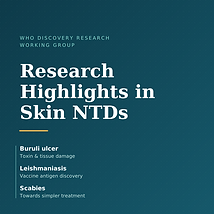
The WHO Discovery Research Working Group for Skin NTDs, established in February 2025 to link basic research with WHO's skin NTD programme, has shared recent member highlights. These include new insights into how the Buruli ulcer toxin mycolactone damages tissue, alongside promising drug and toxin-blocking compounds. Members also identified hundreds of new leishmaniasis vaccine targets from patient lesions and issued a call for coordinated vaccine investment. For scabies, a topical treatment that kills both mites and eggs is in development and could make single-dose treatment possible.


Thank you for reading!
For future correspondence, sharing details of upcoming event or webinar and submission of Working Group updates, please mail at:
ipsita.nhm@gmail.com / comparetm@isntd.org
Or you may contact the Newsletter Team, mentioned here:
Adeola Bamisaiye, Marianne Comparet, Anna Wickenden, Ipsita Ghosh, Nikita Sarah, Michael Head, Priya Pathak, and Yona Yangaza
PUBLISHED BY THE WHO SKIN NTD WORKING GROUP ON ADVOCACY AND COMMUNICATIONS IN COLLABORATION WITH THE WHO SKIN NTDS TEAM, DEPARTMENT OF MALARIA AND NEGLECTED TROPICAL DISEASES, WHO, GENEVA
Disclaimer. The articles in this newsletter reflect the views of their individual authors and contributing working groups. They do not necessarily represent the views, policies or positions of the World Health Organization. The mention of specific organisations, publications, products or external links does not imply endorsement by WHO. This newsletter is for information purposes only and does not constitute medical, legal or professional advice. External links are provided for convenience, and WHO is not responsible for the content of external sites.
The International Society for Neglected Tropical Diseases
